
Pirate Weapons of the Golden Age of Piracy
Pirate Cannons, Pirate Swords, Pirate Guns & Boarding Tactics
Pirate weapons of the Golden Age of Piracy could be very destructive, but they were rarely used the way you might imagine. While modern weapons are designed to destroy enemies from the greatest possible distance, a pirate in the 17th or 18th century used weapons with a very different goal: capturing the enemy’s ship, cargo, and crew with as little damage as necessary to either. This made up-close-and-personal tactics essential — and produced one of the most diverse and ingenious arsenals in military history. All Pirate Weapons & Collectibles on eBay → (Ebay affiliate link)
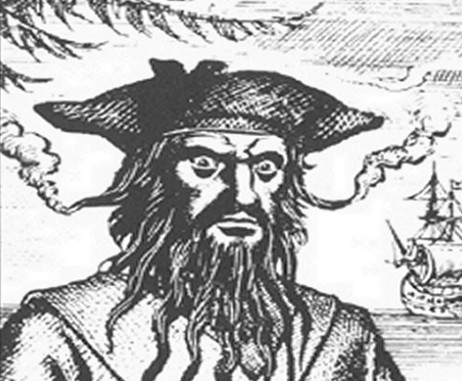
Even Blackbeard, the most fearsome pirate of the Golden Age, understood that a reputation was the most powerful pirate weapon of all — he wore slow-burning fuses in his beard before battle so that smoke would swirl around his head and make him look like a man risen from hell. He rarely needed to fire a shot.
In this article about pirate weapons: Long-range / Medium-range / Close-range / Other Weapons / Weapons Comparison Table / FAQ
Pirate Weapons and Distance
The pirate weapons used in any engagement depended on how quickly the other ship surrendered:
! Negotiations could happen quickly after a pirate cannon’s warning shot or a precise hit to break the main mast or bowsprit.
!! It could escalate to ruining sails, lobbing pirate grenades, or picking off officers with muskets.
!!! The bloodiest fights were last-resort, close-contact melees during and after a pirate boarding party — when all manner of weapons were unleashed.
Medium- to Long-range Pirate Weapons
Reputation: the most powerful pirate weapon of the Golden Age — and the one that cost nothing. A fierce reputation could inspire surrender before a single shot was fired. Flying on the winds of conversation among captains, merchants, and mariners, it could circle the globe. Pirate flags like the Jolly Roger were one of the most effective tools for building and broadcasting that reputation.
Pirate Cannons and Artillery: Pirate cannons required four or more men apiece to load, aim, fire, and reposition. By 1700, improvements in loading, aiming, accuracy, range, and speed made these pirate weapons more formidable — an iron cannonball fired 700–1,000 yards could turn wooden ship parts into deadly splinter missiles and bring down masts in a single hit. Pirates rarely aimed to sink a prize; a ship full of holes was worthless cargo. Chain shot to shred rigging, grapeshot to clear a deck — these were the surgeon’s tools of the pirate cannon.
Several types of pirate cannon shot for 50–500 yards were mainly designed to disable the ship:
-
 Bombs — hollow iron balls filled with powder and topped with a fuse. The goal was explosion on impact, timed by the fuse length. It could reach nearly the same distance as a standard cannonball — but when it arrived, it made a considerably more dramatic entrance.
- Bar Shot — big iron bars that punched large holes through any part of the ship they passed through. The unpredictable trajectory dictated a shorter range.
-
 Chain or Knipple Shot — pairs of small iron balls joined with chain or a bar that rotated through the air and minced any sails and rigging they tangled with, while doing little damage to decks or hulls — a practical medium-range pirate cannon round.
🏴️ Replica Pirate Cannons & Cannon Models on eBay (eBay affiliate link)
Medium- to Close-range Pirate Weapons
Stinkpots were small clay pots filled with burning sulfur (and sometimes plant gums and rotten fish) thrown onto the enemy deck. A crude form of tear gas, the smoke and fumes were designed to overwhelm the enemy’s will to fight. A crew that could not see, could not breathe, and was stumbling over each other was a crew ready to surrender without a fight.

Pirate Hand Grenades — named for the Spanish word for pomegranate, which they resembled — were small glass bottles or clay, wood, or iron pots filled with black powder mixed with broken glass or scrap iron and lit with a fuse. Effective for shrapnel wounds and shock value during pirate boarding actions. Both weapons reflect a truth about pirate warfare that Hollywood rarely captures: the goal was not heroic combat. The goal was the fastest possible end to resistance, with the prize intact.
Anti-personnel pirate cannon rounds:
- Bundle Shot — packs of short metal bars designed to make short work of a crew or passengers on deck.
-
 Grapeshot — bunches of small cast iron balls wrapped in canvas that scattered at close range. Grape was commonly used to cover or repel a pirate boarding party.
-
 Canister or Case Shot — a box or cage filled with grapeshot, bundle shot, or stones, designed to end a fight quickly.
- Just anything — scrap iron, nails, spikes, and yes, when everything else was gone… gold coins. Surgeons were said to have cut coins out of corpses. Definitively the most expensive pirate weapon ever deployed.
Pirate Guns — Lots and Lots of Guns!
-
 Swivel Guns — Portable pirate weapons like large rifles or small cannons that could be mounted in sockets along the rail wherever boarders were attempting to climb aboard. A blast of small cannonballs could eliminate most of the first wave of intruders.
- Muskets — Valued for having greater range than the blunderbuss or musketoon — a quality the buccaneers prized when attacking Spanish ships. At sea they were used in the early stages of a pirate boarding attempt and to pick off helmsmen and officers. The standard musket of the era was the Brown Bess, a .75 caliber flintlock familiar to many pirates from their days as naval sailors. Accurate marksmanship when both ships were rolling with the waves was no easy feat.
- The Pirate Blunderbuss — This muzzle-loading “thunder gun” was like a large shotgun with the firepower of a one-person cannon. Its two-inch bore fanned out to a funnel shape, thought to help disperse small pellets over a wider area. About half the length of a musket with the kick of a mule, this pirate gun was fired from the hip. Its two primary uses were for pirate boarding parties and personal defense. If you were unlucky enough to survive being hit by one, the wounds were crippling and rarely healable.
-
 The Musketoon — Similar to the blunderbuss but shorter, with the same barrel shape. Another close-range pirate weapon for boarding and general combat.
- Flintlock Pistol — Highly valued for its size and maneuverability: equally useful in a pirate boarding action, close-quarters fighting, or a tavern dispute. A muzzle-loading single-shot gun was time-consuming to reload, but after firing, the butt end served for pistol-whipping. Flintlock pistols were often discarded when the fighting intensified and the primary pirate weapon became the cutlass. Blackbeard famously wore three braces of cocked, primed flintlock pistols strapped across his chest when going into battle — six pistols total, fired one after another.
- Multi-barreled Pistols — Varying arrangements of locks and triggers fired fixed or rotating barrels. These unusual pirate weapons were in demand despite being bulky, costly, and often unpredictable.
- Pocket Pistols — The forerunners of the Derringer: tiny muzzle-loaded guns of convenience placed where they could be retrieved quickly for a last-minute shot.
-
 Volley Guns — In pistol or rifle form, these pirate weapons fired several barrels simultaneously, forming a wall of shot that any boarder would be daring to cross. Reloading, however, required what might charitably be called a pause in the action.
🏴️ Replica Flintlock Pistols on eBay | Replica Blunderbusses on eBay (eBay affiliate links)
Close-range Pirate Weapons: Cutlass, Knives & Blades
The Pirate Cutlass is the weapon most associated with pirates of the Golden Age — and for good reason. It was the one weapon that kept working after all the guns were discharged; a flintlock pistol took precious time to reload, but another slash was just an arm swing away. Shorter than swords or sabers and with a broader, sturdier, curved blade, the pirate cutlass was ideal for fighting in the close confines of a ship’s deck or below. Its knuckle guard could deflect a blade or be used like brass knuckles when the fighting got truly desperate.
The pirate cutlass is believed to have evolved from the ‘Boucan’ hunting knife of the French buccaneers, whose blades needed to be sturdy enough for cutting lines, breaking down doors, and dividing pieces of eight as well as fighting. Handles offered cushioning with leather wrapped on bone or ivory stock. Advances in steel forging during the late 1600s allowed the blade to be thinner and lighter without sacrificing its ability to bash aside opposing weapons.
🏴️ Pirate Cutlasses on eBay | Pirate Swords on eBay (eBay affiliate links)
Daggers and Dirks — the smaller pirate knives:
- The Dagger — a small multipurpose pirate knife with a straight blade for thrusting and puncturing rather than slashing. The crossbar or hilt was critical in cutlass fights: it could catch a blade strike, deflect the blow, and open the counter-cut.
- A Dirk — a particular type of small pirate knife designed primarily for throwing, smaller than a dagger (compare to the Bowie knife or stiletto).
-
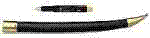 Scabbards — Many pirates came from naval backgrounds and brought with them the discipline of keeping clean weapons. A scabbard for every knife was standard practice aboard a pirate ship. The pirate articles most crews signed specifically required every man to maintain his arms — failure was a punishable offense.
🏴️ Pirate Daggers & Dirks on eBay (eBay affiliate link)

Boarding Hooks were attached to lines and hurled onto the enemy ship to pull it close, then the two vessels were lashed together for the pirate boarding party to cross. Multiple hooks from multiple crew members made escape nearly impossible once the process began. It was not a weapon of violence — it was a weapon of inevitability.
Other Pirate Weapons
Boarding Axes — with a two- or three-foot handle and a combination of sharp blade and blunt hammer, these pirate weapons cut ropes from boarding hooks, brought down masts and rigging, and tore through doors, hatches, and locks. Some pirate ships maintained specialist boarding teams equipped with axes, whose job was to be first over the rail, creating chaos before the main crew followed. Their size and shape made them unwieldy as pure fighting weapons — but someone always proved to be the innovator.
🏴️ Pirate Boarding Axes on eBay (eBay affiliate link)

The Marlinespike — a steel, wood, or bone pick essential for working with ropes and lines — held a special status as the most likely improvised pirate weapon among crew members contemplating mutiny. When grievances about pay and leadership boiled over, someone always reached for the marlinespike.
Pirate Weapons Comparison — Golden Age of Piracy
How the major weapons of the Golden Age compared across key battlefield factors. Scroll right on small screens.
| Weapon | Type | Effective Range | Rate of Fire | Stopping Power | Wet Weather |
|---|---|---|---|---|---|
| Cannon | Artillery | Up to ¼ mile | 1–2 shots/min | ★★★★★ | Moderate risk |
| Musket | Long gun | 50–100 yards | 2–3 shots/min | ★★★★ | High risk |
| Flintlock Pistol | Sidearm | 10–20 yards | 1 shot; carry multiples | ★★★★ | High risk |
| Blunderbuss | Scatter gun | Under 20 yards | 1 shot/reload | ★★★★★ | High risk |
| Cutlass | Blade | Arm’s reach | Continuous | ★★★★ | Not affected |
| Boarding Axe | Blade / tool | Arm’s reach | Continuous | ★★★ | Not affected |
| Hand Grenade | Thrown | 15–25 yards | Throw & done | ★★★ | Fuse risk |
| Stinkpot | Chemical | 10–20 yards | Throw & done | ★★ | Moderate risk |
| Grappling Hook | Tool / weapon | 15–30 yards | N/A | ★ | Not affected |
| Marlinespike | Improvised | Arm’s reach | Continuous | ★★ | Not affected |
Frequently Asked Questions — Pirate Weapons
Answers to the most commonly asked questions about weapons in the Golden Age of Piracy.
The cutlass was the most universally carried weapon among Golden Age pirates. Unlike firearms, it never misfired, never needed reloading, and never failed in wet weather. It was also inexpensive, easy to maintain, and perfectly suited to the cramped confines of a ship’s deck. The flintlock pistol was nearly as common, though pirates typically carried several at once rather than relying on a single shot.
Yes, but not in the way most people imagine. Pirates used cannons primarily to disable a target ship rather than destroy it — a sunken prize was a worthless prize. They favored chain shot to shred rigging and sails, and grapeshot to clear enemy decks of crew before boarding. Most pirate vessels carried far fewer cannons than naval warships, and avoided battles with heavily armed naval ships entirely.
Historical accounts describe Blackbeard carrying six pistols — three braces of cocked, primed flintlocks strapped across his chest — when going into battle. Since each pistol could only fire once before a lengthy reload, carrying multiple weapons was standard practice for any pirate expecting close-quarters combat. After firing, the heavy pistol butt could also be used as a club.
The cutlass was shorter, heavier, and broader than most contemporary swords, with a single cutting edge and a protective knuckle guard. Where a rapier required space to thrust and years of technique to master, the cutlass was designed for raw power in tight spaces. Its heavy blade could bash aside other weapons, and it doubled as a working tool for cutting rope, clearing brush, and breaking through doors. Long swords were simply impractical on a ship deck cluttered with ropes, barrels, and fighting men.
Because they wanted the ship and its cargo intact. Dead crew members couldn’t be ransomed or recruited. A ship full of cannonball holes couldn’t be sailed to port and sold. Pirates were motivated by profit, not destruction. The ideal attack ended with a bloodless surrender — the black flag alone, or a single warning broadside, often achieved this. Boarding and hand-to-hand combat was the last resort, not the goal.
A stinkpot was a ceramic or clay container packed with burning sulphur, rotten fish, and other noxious compounds, fitted with a slow fuse. When thrown onto an enemy deck it produced a choking, blinding cloud of chemical smoke — no explosion, no shrapnel, just chaos. A crew stumbling around unable to breathe or see was a crew that would surrender far more quickly than one merely taking casualties. Daniel Defoe described its effect in his 1720 novel Captain Singleton.
Almost certainly not. Hollywood pirate duels — elaborate, athletic, drawn-out affairs with rapiers on narrow staircases — bear little resemblance to historical reality. Real shipboard combat with cutlasses was brutal, fast, and terrifyingly close. A pirate typically carried both a cutlass and a pistol, using the blade to deflect the opponent’s weapon while firing the pistol at point-blank range. The goal was to end the fight in seconds, not to display swordsmanship.
Chain shot consisted of two iron cannonballs connected by a length of chain, fired together from a cannon. As it flew through the air it spun in a tumbling arc that was devastating to rigging, sails, and masts — the parts of a ship a pirate most wanted to destroy. Cutting down a mast left a merchant vessel immobile and helpless without sinking it, making chain shot the ideal opening move in a pirate attack.
Yes — and it was a matter of discipline enforced by the pirate code. Most pirate articles (the contracts crews signed) specifically required every man to keep his weapons clean and in working order, with punishment for failure. A misfiring pistol or a rusted blade in a boarding action could be fatal. Some accounts even describe buccaneers practicing marksmanship by shooting coins tossed into the air. The most successful pirate crews were surprisingly well-organized military units, not the chaotic rabble of popular imagination.
⚔️ Shop Complete Pirate Weapons Sets on eBay → — cutlass, pistol, and dagger together
As both an Amazon and eBay Associate I earn from qualifying purchases.
All content ©2003– The Pirate's Realm unless otherwise noted. All rights reserved.
Privacy Policy